
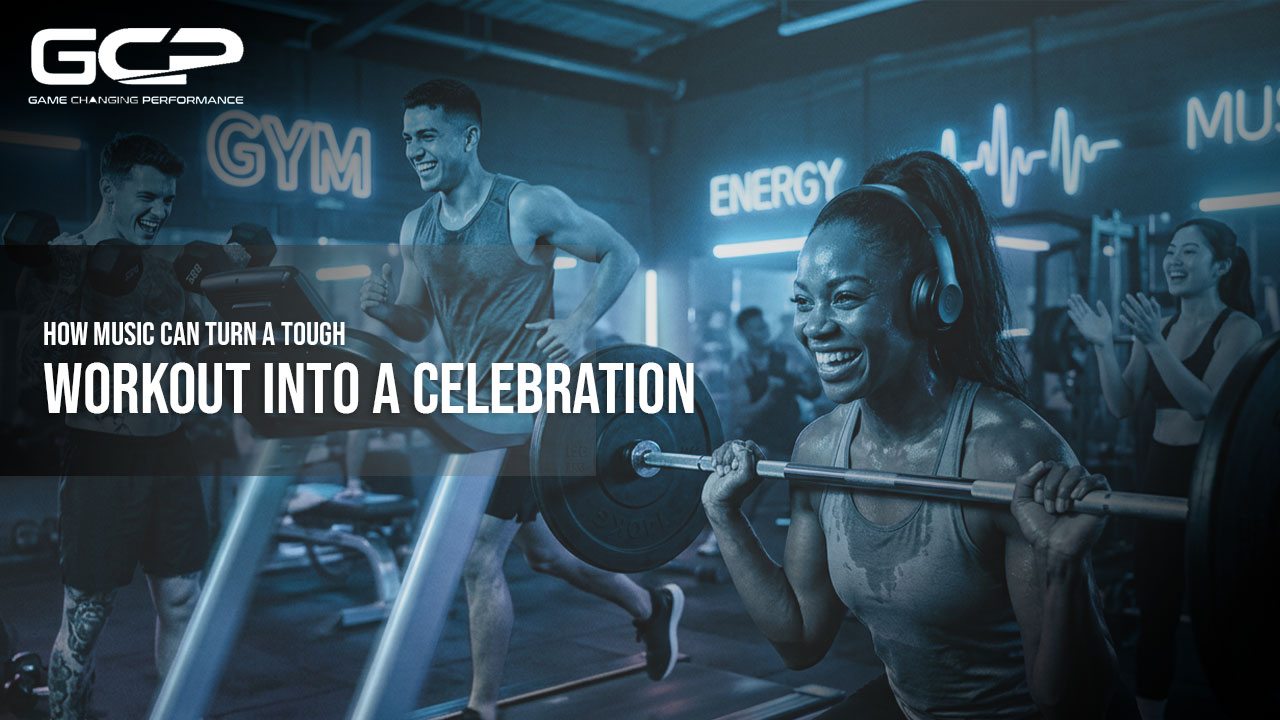
How Music Can Turn a Tough Workout Into a Celebration | Game Changing Performance
Let's be honest about something that rarely gets said in a serious fitness conversation.
The right song at the right moment has carried people through workouts that willpower alone never could have.
You know the feeling. You're eight minutes into something that was supposed to be a warm-up and it already hurts a little more than you expected. Your legs are arguing with you. Your brain is halfway out the door. And then a song drops, the one, and suddenly you're not thinking about how hard it is anymore. You're just moving. You're not surviving the workout. You're celebrating it.
That shift is not imaginary. It is not just mood. It is measurable, repeatable, and rooted in real science. And at Game Changing Performance in Mundelein, we understand that what's playing in the room is just as intentional as what's programmed on the whiteboard. Because the environment you train in, every element of it, shapes what you're capable of inside it.
Why Music and the Brain Are a Perfect Training Partnership
Before we get into playlists and tempo and all the practical stuff, it helps to understand what's actually happening when you put in your earbuds and press play.
Music activates the brain's reward circuitry in a way that few other inputs can match. Specifically, it triggers the release of dopamine, the same neurotransmitter responsible for motivation, anticipation, and pleasure. Research published in sports science journals has consistently shown that music during exercise reduces the perception of effort, improves endurance output, and elevates mood throughout the session.
Here is the key word: perception. Music doesn't make the workout easier. It changes how hard it feels. And in fitness, that distinction matters enormously. Because the biggest limiter for most people isn't physical capacity. It's the mental ceiling that says "this is too hard" before the body has actually reached its limit.
Music pushes that ceiling higher without you even noticing it's happening.
There's also something called synchrony, where your movement naturally begins to match the rhythm of what you're hearing. A track with the right beats-per-minute doesn't just feel good, it actually paces you, keeps your cadence consistent, and can improve mechanical efficiency during cardio or circuit work. Your brain locks onto the beat and uses it as a metronome. You become a more efficient mover, often without trying to be.
And beyond the science, there is something purely human about music that no data can fully capture. A song can reach into your memory and pull out a version of you that felt strong. It can anchor you to a moment when you decided things were going to be different. It can make a Tuesday evening group session feel like the opening scene of a movie about someone becoming the best version of themselves.
That's not soft. That's powerful.
The Tempo Effect: Why BPM Actually Matters
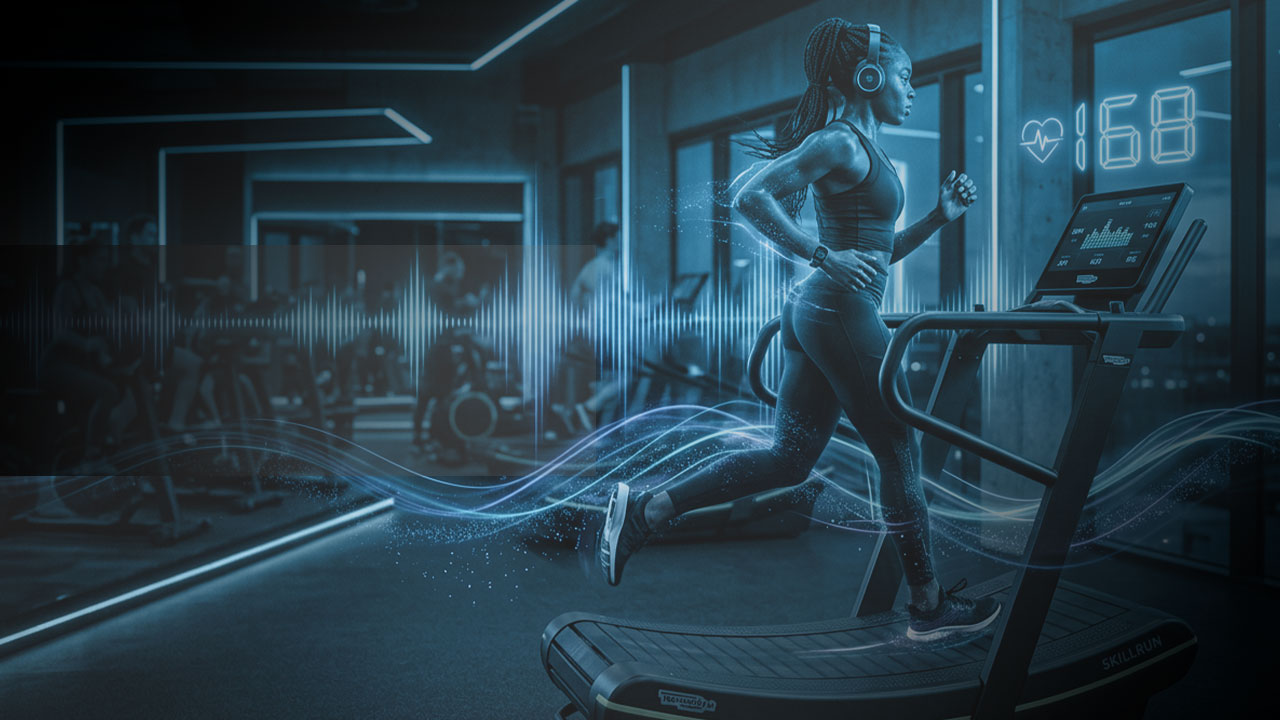
Not all music produces the same training response. The science gets specific here, and it's worth understanding.
For low-to-moderate intensity work, mobility, warm-ups, steady-state cardio, music in the range of 120 to 130 beats per minute tends to match natural movement rhythm and promote a calm, sustainable effort. Think of this as the soundtrack that keeps you going without spiking your nervous system before you're ready.
For high-intensity intervals, strength circuits, and the kind of work where you need to flip a switch, 130 to 150 BPM is where things get serious. The rhythm is driving. The energy is urgent. Your nervous system reads that urgency and responds by recruiting more. Studies on athletes and recreational exercisers alike have found that higher tempo music during peak effort produces measurably higher power output than silence or mismatched music.
For cooldowns and recovery, slower tempos, below 100 BPM, help bring heart rate down faster and shift the nervous system from fight-or-flight back toward rest and recovery. The music is literally helping your physiology regulate itself.
This is why a thoughtfully programmed playlist is a performance tool, not a preference. And it's why at GCP, the music isn't random background noise. It's part of the training design.
Ready to experience a training environment where every detail is built for your success?
Book Your Free Transformation Strategy Session at GCP Today!
5 Ways Music Transforms a Workout From Hard to Celebratory
1. It Reframes the Effort
Pain and pleasure share brain real estate. When music activates reward pathways during effort, the experience of that effort changes. The burn in your legs doesn't disappear, but it stops being the loudest thing in the room. Your brain has something more interesting to process. This is the distraction effect, and it is one of the most well-documented benefits of music in exercise research.
The practical result? You go longer. You push harder. You stop watching the clock. You're not white-knuckling through the last set. You're riding a wave you didn't even know had carried you there.
2. It Creates Emotional Anchors
There is a reason certain songs make you feel invincible the moment the intro hits. Your brain has tied that song to a memory, an emotion, a previous version of a workout where you showed up for yourself. Psychologists call this a conditioned response. In training terms, it means you can engineer your emotional state before you even touch a weight.
At Game Changing Performance, we've watched members walk in already in a different headspace just because of what's playing when they arrive. That transition, from the outside world to the training floor, is faster and sharper when the music meets them right. The gym starts to feel like a place where a different version of you lives. A stronger one.
3. It Regulates Intensity
Left to their own devices, most people either go too hard too early and burn out, or stay too comfortable and never actually push. Music provides a natural intensity regulator. The tempo pulls you up when you're dragging. The rhythm slows you down when you're racing. For group training especially, a shared musical experience creates a shared pace, which means the room is working together even when everyone is doing their own thing.
This is one of the subtler ways that GCP's training environment creates results that solo gym workouts can't replicate. When thirty people are moving to the same rhythm in a space designed for that shared energy, the output of every individual in the room goes up.
4. It Activates Identity
This connects back to something fundamental about how habits and motivation actually work. When you have a training playlist, a specific, intentional collection of music that you associate with your best sessions, you're building more than a soundtrack. You're building a ritual. And rituals signal identity.
The moment you put on that playlist, your brain receives a message: We are a person who trains. This is what we do. That identity cue lowers activation energy. It reduces the gap between "I should work out" and "I am working out." The music becomes part of who you are in the gym, and who you are in the gym starts to reshape who you are outside of it.
5. It Makes the Celebration Possible
Here's the thing most fitness culture gets wrong. It frames exercise entirely as sacrifice, the pain you endure for the results you want. And when training is only sacrifice, it will always feel like something you have to force yourself to do.
Music introduces joy into the equation. Not manufactured positivity. Actual neurochemical joy. The kind that makes you want to come back tomorrow not because you have to, but because yesterday felt good. That is the shift from consistency being a battle to consistency being a default. And it starts with something as simple as the right song at the right moment.
What This Looks Like at Game Changing Performance in Mundelein
Everything described above isn't theory at GCP. It's practice.
Our coaches understand that the physical environment, the lighting, the energy in the room, and yes, the music, is not decoration. It is infrastructure. It is part of what makes a tough workout feel like a win rather than a sentence.
When you walk into a GCP session, you walk into a room that has been designed to shift your state. The playlist isn't someone's random Spotify shuffle. The energy in the space is intentional. The coaches know that getting you mentally in the training headspace is as important as the warm-up, because a mind that's engaged produces a body that performs.
And that same philosophy runs through everything else we do. The coach-led programming removes decision fatigue so your mental energy goes into the work, not the planning. The community around you creates a shared rhythm that pushes everyone to their best. The real-time tracking via Wodify Pulse gives your brain immediate feedback, another form of reward that makes the effort feel worthwhile.
We have members who will tell you they dreaded the gym for years before finding GCP. Not because they weren't capable, but because they'd never been in an environment that actually understood what it takes to make hard things feel good. That's what happens when you stop thinking about fitness as just programming and start thinking about it as experience design.
Want a training experience where showing up actually feels good?
Explore Our Accelerated Fat Loss Program at GCP!
Frequently Asked Questions
Does it matter what genre of music I listen to during workouts?
Genre matters less than you'd think. What actually drives the training benefit is tempo, personal connection to the music, and the emotional state the song produces in you. A country song that fires you up will outperform a hip-hop track that leaves you cold every time. The research supports that individual preference plays a meaningful role, so while BPM guidelines are useful, your personal playlist should ultimately be built around what moves you.
Is it better to use headphones or train in a group environment with shared music?
Both have real benefits. Headphones allow for deeply personal musical experience and can be powerful for solo training or focused effort. Shared music in a group environment adds the element of social synchrony, where collective rhythm creates collective energy. At GCP, we use shared music deliberately because the group dynamic amplifies it. When everyone is moving to the same beat in the same space, the sum is genuinely greater than the parts.
Can music become a crutch? What if I can't train without it?
This comes up more than people expect. Music dependency in training is a real thing, but it's worth putting in perspective. The goal of any good training habit is to make showing up as easy as possible. If music is what makes the environment feel right for you, that's not a weakness, that's knowing your system. Where it can become limiting is in competition or performance contexts where you can't control the audio environment. For most everyday members focused on fat loss, fitness, and feeling good, the benefits of training with great music far outweigh the downside of preference.
What BPM range does GCP recommend for high-intensity sessions?
For peak effort intervals and strength circuits, we find that 130 to 145 BPM tends to produce the best combination of drive and control. High enough to energize, without being so frantic that it disrupts form or breathing rhythm. For warm-up and cooldown phases, we drop into the 100 to 120 BPM range to match the lower-intensity demand of those periods. The goal is always to match the music to the moment.
How do I build a training playlist that actually works?
Start with five to ten songs that have made you feel powerful in the past, in any context, not just the gym. Then check their BPM (any music streaming app can help with this) and arrange them so intensity builds gradually, peaks during your hardest effort, and then eases back. Treat it like a session arc. And revisit it every few weeks, novelty matters, and the brain responds to new music with a small dopamine surge that can re-energize stale sessions.
Stop Fighting the Workout. Start Celebrating It.
Fitness doesn't have to feel like punishment every time. The difference between a session you survive and a session you celebrate is often not the programming, not the weight on the bar, and not even your effort level. It's the environment. It's whether the space you're in understands what it takes to bring out your best, mentally and physically.
Music is one piece of that environment. Community is another. Expert coaching is another. Real-time feedback is another. And when all of those pieces come together in the same room, what felt like a tough workout stops feeling like something you drag yourself to and starts feeling like something you actually look forward to.
That's what Game Changing Performance in Mundelein is built around. Not just getting bodies fitter. Creating an experience that makes people want to keep showing up, for weeks, months, and years, until the version of themselves they used to imagine is just the person they recognize in the mirror.
The right song can carry you through one session. The right environment can carry you through a transformation.
Ready to train somewhere that makes every session worth showing up for?